
By Brian Butler | ATB Technologies | October 28, 2026
We have a familiar way of talking about technology projects.
We define the requirements. We build the solution. We test it. We deploy it. We close the project. That model works reasonably well when the system behaves predictably after implementation.
When it comes to AI agents, we need to think differently.
They operate against changing data. They connect to changing applications. They interpret changing instructions. They encounter situations we did not anticipate. Their costs move with usage. Their behavior can shift when models, prompts, tools, or business rules change.
At what point do we call the implementation complete? This is the root of the challenge. Sure, the deployment may be complete, but the operating responsibility has just started.
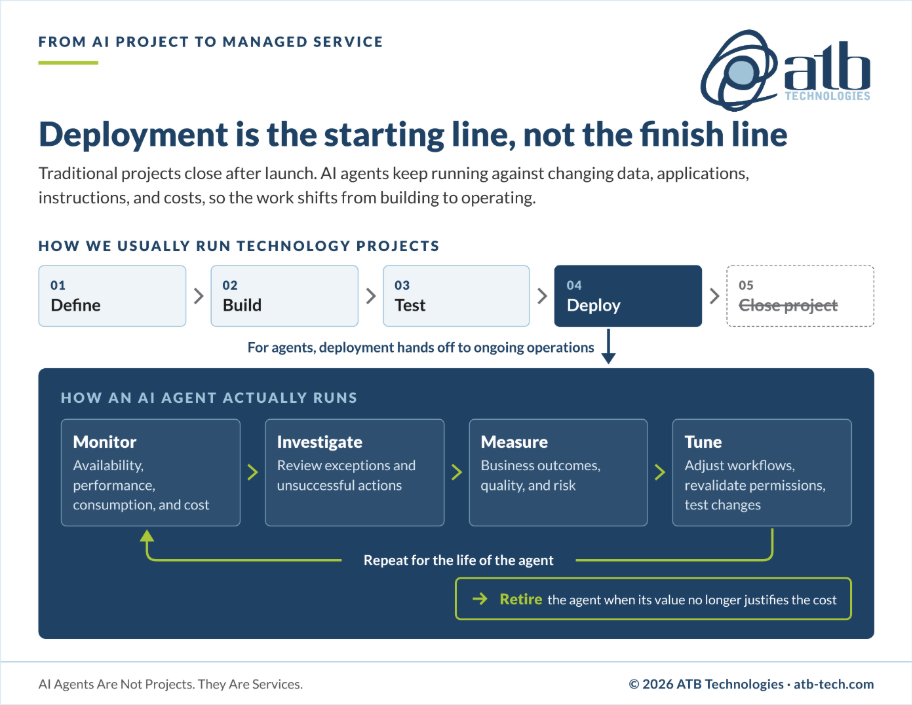
A Successful Launch Proves Very Little
Most of us have experienced a successful demonstration working under favorable conditions. The data is available. The API responds. The customer request fits the expected pattern. The prompt behaves. The workflow completes. We celebrate the completion and we start looking for the next project.
However, production is where the interesting problems begin.
What happens when the CRM is unavailable? What happens when a customer asks for an exception? What happens when the source document is wrong? What happens when permissions change? What happens when usage triples?
Does the agent fail safely? Does someone receive an alert? Can we reconstruct what happened? Can we reverse the action? Does a person know they are accountable for what the agent did or didn’t do?
A successful demo proves that the path works. It does not prove that the service is operationally ready.
Value Changes Over Time
Even an agent that creates value today may not create the same value six months from now.
The workflow may change. Employees may stop using it. Model costs may increase. A new integration may add failures. Quality may drift. The business may remove the bottleneck the agent was designed to address.
Does that mean the agent failed? Not necessarily. It means the agent needs to be managed.
Traditional infrastructure teams already understand this idea. We do not declare a server permanently successful because it passed its deployment test. We monitor availability, performance, capacity, security, cost, and incidents throughout its life.
Agents need the same operational discipline, plus one more layer: business outcomes.
Five Operating Signals
When we manage an agent, we need visibility across five categories.
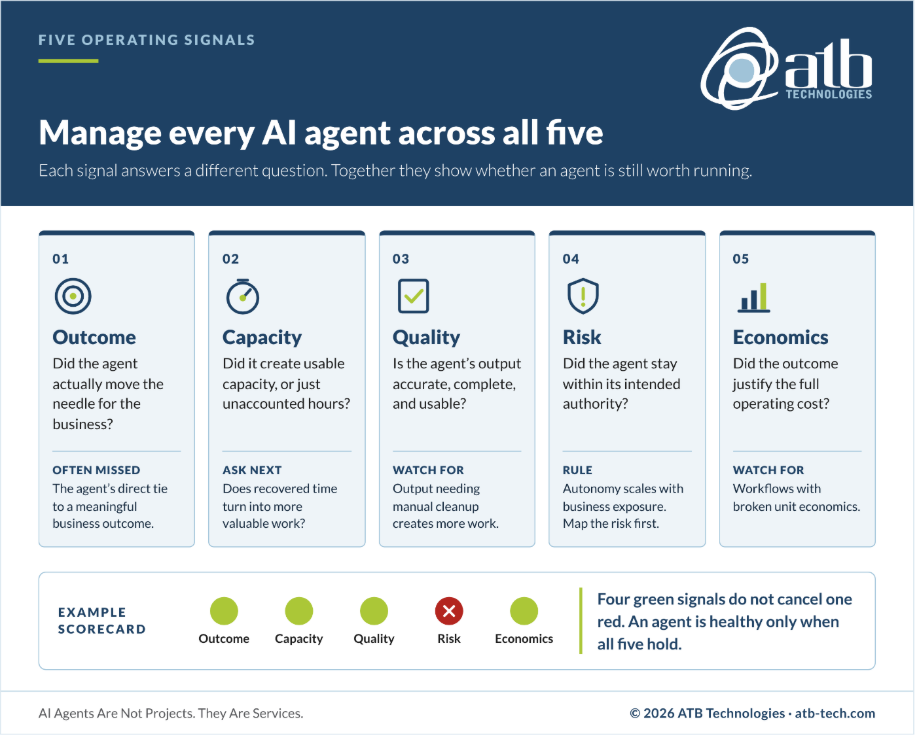
- Outcome: Did the agent actually move the needle for the business? Too many teams focus on technical feasibility and speed, obsessing over whether an agent can do the work and how fast it completes it. What gets consistently overlooked is the agent’s direct tie to meaningful business outcomes. Without a clearly defined outcome, success cannot be measured, and the return on investment stays unverified.
- Capacity: Did the agent create usable capacity, or did it just free up unaccounted hours? Modern agents process work quickly, making raw time savings easy to claim on paper. The harder challenge is making sure recovered time turns into higher-value work. If a direct link cannot be made from an employee’s increased output back to the bandwidth the agent unlocked, the efficiency gain remains theoretical.
- Quality: Is the agent’s output accurate, complete, and usable, or is it just finishing tasks? Running a workflow a thousand times means nothing if the output requires manual cleanup to be usable. At that point, automation creates more work than it eliminates. An unmeasured agent cannot prove its worth, and when evaluating agents, quality always trumps throughput.
- Risk: Did the agent stay within its intended authority, or did it expose the business to unacceptable risk? Agent autonomy is not one-size-fits-all; it must scale directly with potential business exposure. High-stakes workflows demand strict guardrails and minimal autonomy, while low-risk tasks can run with a much longer leash. The responsibility sits with leaders to map and quantify that risk profile before granting an agent permission to act.
- Economics: Did the outcome justify the full operating cost? Too often, teams build agents for tasks that lack a viable business case. Agents can create massive value, more than most companies realize, but picking workflows with broken unit economics will sink the ROI.
So, what does this mean? Each signal matters. An agent may be technically reliable but financially wasteful. It may create capacity while producing poor-quality work. It may improve conversion while operating with permissions that create unacceptable exposure.
In other words, a green status in one category does not cancel a red status in another.
Exceptions Tell the Truth
Success metrics tell us what the agent handles well. Exceptions tell us whether we built something durable.
Which requests require human intervention? Which systems fail most often? Which outputs need correction? Where does the agent become uncertain? What kinds of customers or transactions fall outside its boundaries?
Those are not merely support issues. They are product intelligence.
A well-managed exception process helps us decide whether to:
- Improve the prompt.
- Correct the source data.
- Change the workflow.
- Narrow the agent’s authority.
- Add a deterministic rule.
- Train employees.
- Expand the agent’s capability.
- Retire a use case that does not justify its complexity.
An exception queue is not evidence that the agent failed. An exception queue nobody reviews is.
Somebody Has to Operate It
The AI agent does not own its outcome. The software vendor does not understand the full business process. The employee using it cannot usually manage the architecture, integrations, security, cost, and evaluation model alone.
Who owns performance? Who monitors failures? Who reviews access? Who manages changes? Who reports value to leadership?
If those questions do not have clear answers, the organization has an AI experiment and is not ready to run an operational AI agent.
Thomson Reuters’ 2026 AI in Professional Services Report found that only 18% of respondents say their organization tracks AI ROI. KPMG’s Global AI Pulse (Q3 2026) found that only 12% consistently assess AI value against cost across the organization. These are staggering numbers. The implications are that we have businesses operating on a gut feeling at best and possibly just running blindly. The truth is that the measurement gap is probably not caused by a shortage of dashboards. It is caused by unclear operating ownership.
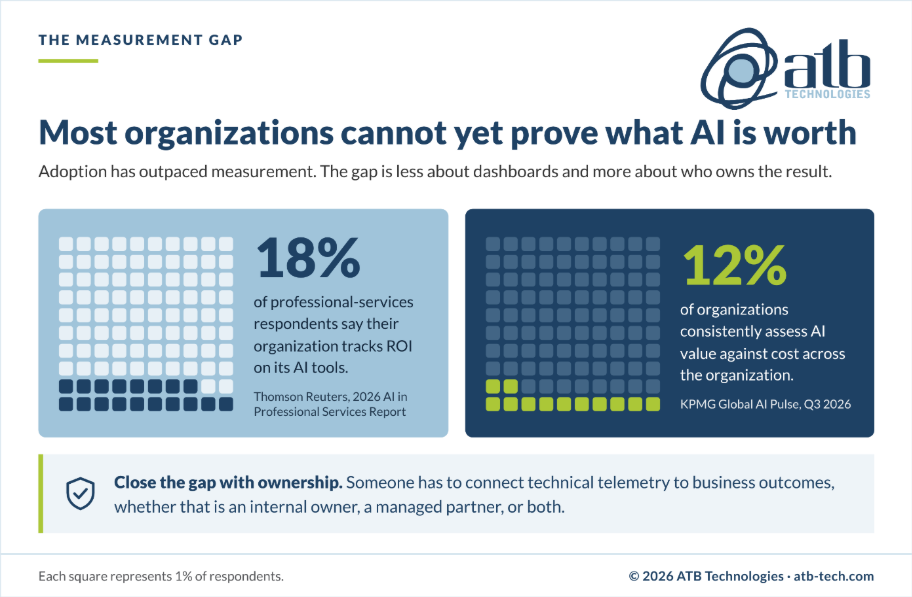
Someone must connect technical telemetry to business outcomes.
From AI Project to Managed Service
For smaller companies, the answer is not necessarily to build a large internal AI department. But the responsibilities still exist:
- Monitor availability and performance.
- Review unsuccessful actions.
- Investigate exceptions.
- Track consumption and cost.
- Revalidate permissions.
- Test changes.
- Measure business outcomes.
- Report risk.
- Tune workflows.
- Coordinate human oversight.
- Retire agents that no longer justify their cost.
We can distribute those responsibilities internally. We can assign them to a managed partner. In many environments, we will use a combination of both.
What we cannot do is pretend they disappear after launch.
The difference between an AI demonstration and a business capability is whether we can operationalize it. Once we do, we have something that transforms the business.
Building the agent proves it can work. Managing the agent proves it continues to matter.
Curious how your agents would score across the five operating signals? ATB Technologies helps organizations monitor, measure, and manage AI agents as ongoing services. Let’s start the conversation at atb-tech.com.