
Written by: Brian Butler | ATB Technologies | July 20, 2026
If a business spends more on AI every quarter while the work moves at exactly the same speed, something is wrong. Not with the tools. With the assumption underneath them.
Most of us have quietly accepted the belief that buying AI makes a company faster. Is that true? Sometimes. Is it reliable? No. Is it the thing separating the companies pulling ahead from the ones standing still? I would be willing to venture that it is not.
The data makes the gap hard to ignore is a Goldman Sachs survey of small businesses found that 76% report actively using AI and 84% see real efficiency gains, and yet only 14% have embedded AI into their core operations.
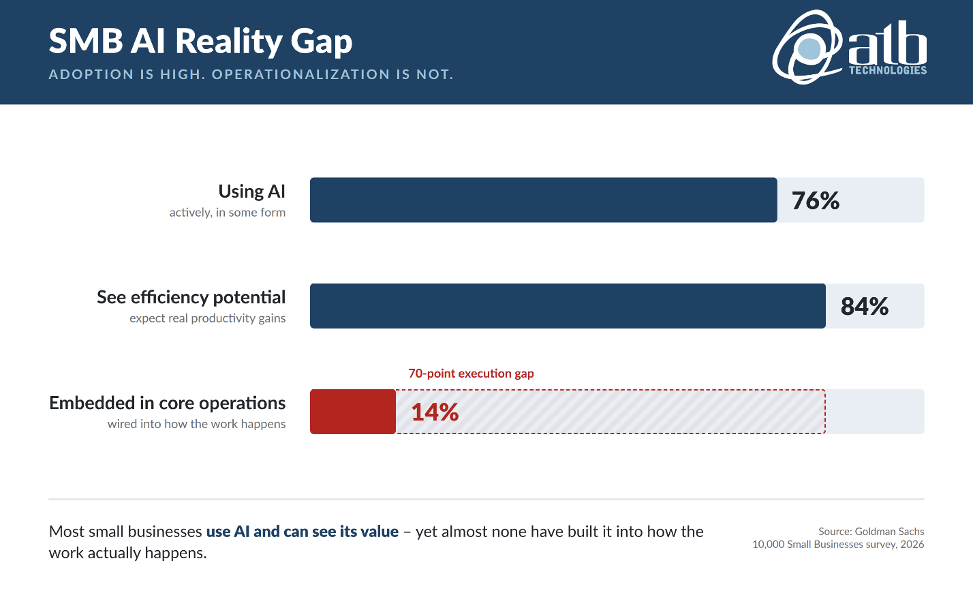
So, we are using AI. We can see the value. And still, almost none of us have wired it into how the work actually happens. Why?
The answer is uncomfortable. AI alone does not make companies fast – operational architecture does. The frontier AI labs and the fastest startups are not shipping faster because they hold some secret model. They are shipping faster because they changed how their companies operate. They moved repeatable coordination, decisions, and documentation out of endless status meetings and into structured systems where agents can act against them. If we simply layer several new AI tools on top of the same meeting-heavy, document-scattered operating model we ran in 2020, we are not transforming. We are accumulating digital clutter.
The trap of partial adoption
Most SMBs land in what analysts call partial adoption. A study of SMB AI readiness from SAS and IDC found that roughly 70% of small and mid-sized businesses sit in “experimental” or “opportunistic” stages – buying per-seat licenses for individuals who use them in isolation, with no shared data foundation, no governance, and no workflow redesign underneath.
That pattern fails in two predictable ways, and it is worth naming both.
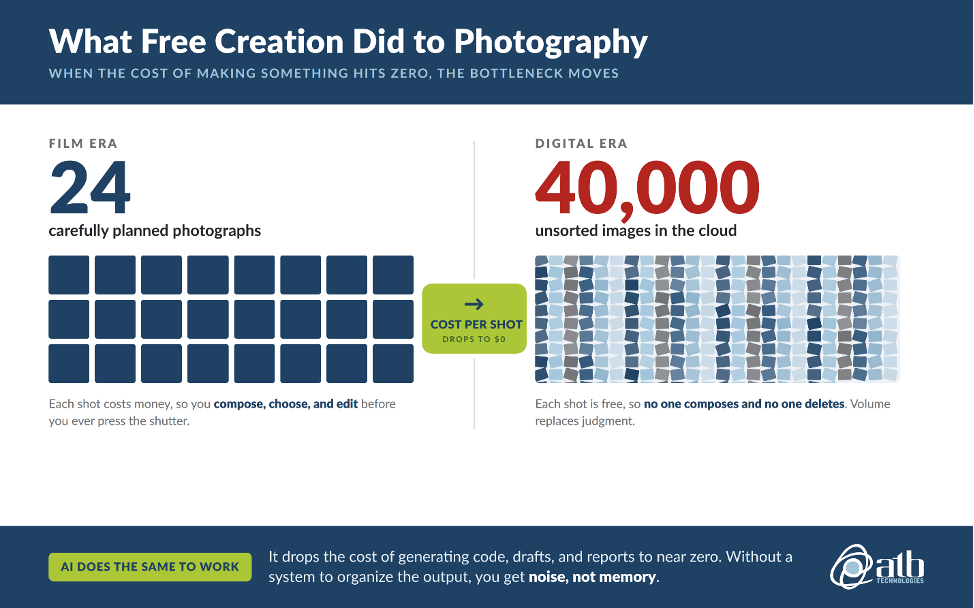
Let us consider a non-technical example. When film was expensive, a person took 24 careful photographs on a vacation. When digital made each shot free, we ended up with 40,000 unsorted images in the cloud. AI does the same thing to the workplace: it drops the cost of generating code, drafts, reports, and copy to nearly zero. But when employees generate mountains of unguided content over a messy internal knowledge base, senior managers spend more time editing and repairing AI “slop” than it would have taken to write the thing by hand. The bottleneck moved. It did not disappear.
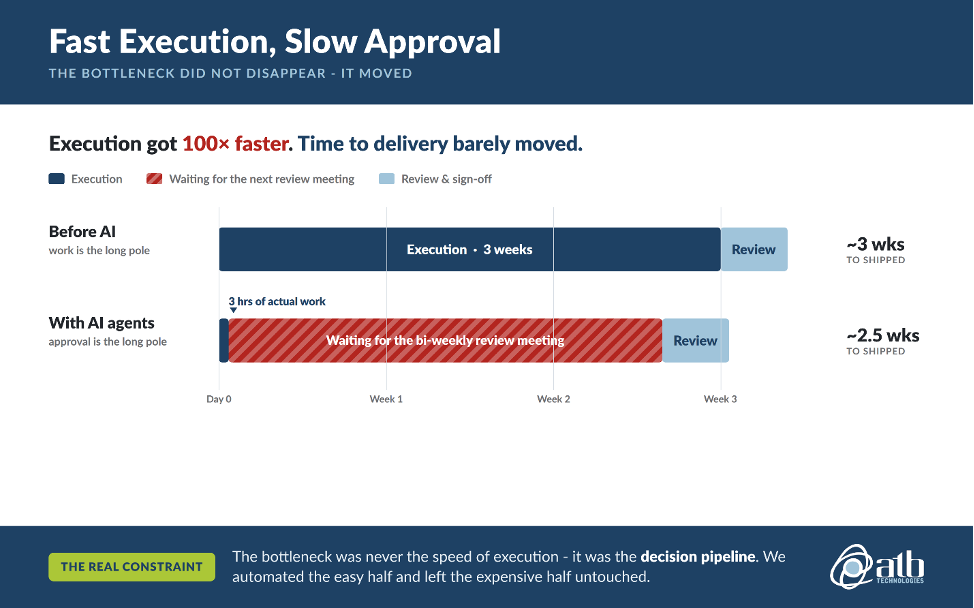
The second failure is quieter. An operations team uses agents to produce a working prototype in three hours instead of three weeks – and then it sits, waiting for a bi-weekly review meeting to approve it. Was the constraint ever the speed of execution? No. The constraint was the decision pipeline. We automated the easy half of the work and left the expensive half exactly where it was.
Three pillars, not one patch
Partial adoption fails because AI integration is not a software patch. It is an interconnected system. Change the tooling without changing the documentation and the human habits, and all we manufacture is friction.
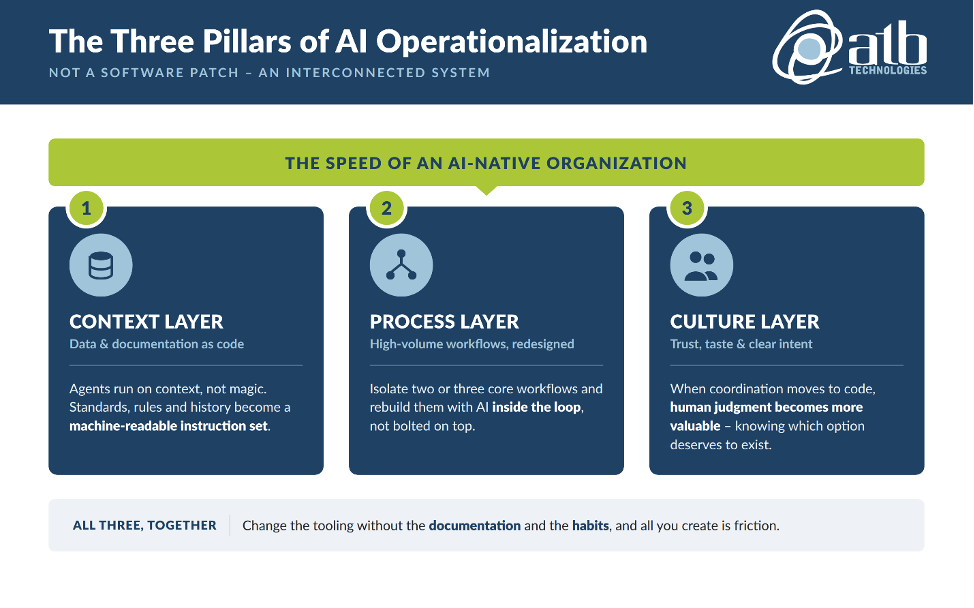
The first is context. Agents do not run on magic – they run on context. If our standard procedures, client histories, and business rules live inside people’s heads, scattered Slack and Teams threads, or outdated PDFs, the AI will fail. This part is not complicated, but it is unforgiving: AI changes what our reporting and our decisions look like only if it has clean, consistent access to the underlying data. In an AI-native company, documentation is treated like production code – the machine-readable instruction set that tells an agent the standards, the permission boundaries, and the escalation paths.
The second is process. We cannot automate a process we have never mapped. The businesses that succeed avoid the broad “AI rollout” entirely. They isolate two or three high-volume workflows – client onboarding, proposal generation, ticket triage – and rebuild those with AI inside the loop. Coordination moves out of the long meeting and into a living artifact that people test and validate in real time.
The third is culture. Technology alone rarely fails – human adoption does. And here is the part most leaders miss: when repetitive coordination moves to code, the value of human judgment does not fall. It climbs. An agent can generate ten versions of a campaign or a project plan. It takes taste, domain knowledge, and customer empathy to know which one deserves to exist. Deloitte’s research on AI-ready cultures points the same direction – the organizations that invest seriously in change management, incentives, and training are meaningfully more likely to exceed their AI goals than the ones that simply buy licenses and hope.
Why the small team wins
This may sound daunting for a 40-person company. It should not. If anything, the advantage here belongs to the small team.
McKinsey found that only about 1% of leaders describe their AI deployment as mature. The giants are trapped – committee reviews, rigid org charts, compliance webs that make any real change agonizing. An agile SMB of 20 to 250 people can overhaul its core operating habits in weeks, not fiscal years. Replace slow review cycles with clear documentation and agentic pipelines, and a lean business can out-ship a competitor ten times its size. Is that an exaggeration? Probably not. Speed of change is the one arena where being small is the asset, not the handicap.
From buying tools to building the engine
So, what is the actual first move? It is not another subscription.
Buying more SaaS will not fix a broken workflow, and it is worth sitting with that. Goldman Sachs found that 73% of small businesses using AI say they need outside help – implementation support and training – to capture real value. What SMB leaders need is not one more chatbot seat. It is a partner who can help build, structure, and maintain the operational engine underneath the tools: the data foundation, the documentation system, and the workflows where agents actually do the work.
That is the work we do at ATB Technologies. We do not sell a license and walk away. We build and manage the data architecture, the documentation, and the agentic workflows that let the AI a company already owns finally earn its cost. If a first step is useful, it is a plain one – an audit of where human friction, not compute, is the real rate limit on growth.
In closing, let me return to those 40,000 photographs. The problem was never the camera. It was that free capture, with no system to organize it, produced noise instead of memory. AI is the same bargain at a far larger scale. The tools are already cheap and already good. What remains scarce – and what will separate the companies that pull ahead from the ones that stall – is the architecture, the judgment, and the discipline to point all that capacity at something worth keeping.
Ready to see where your business actually stands?
CLAIR, our Consultant-Led AI Readiness assessment, evaluates all six dimensions – deployment, systems, data, outcomes, people, and governance – together, not in isolation. Book a CLAIR assessment.
Contact ATB Technologies today!
About ATB Technologies
ATB Technologies is an award-winning managed service provider (MSP) that helps businesses solve technology problems and navigate which solutions best support their business strategy and goals. Our IT experts help companies maximize their business IT while offering an exceptional level of customer service. We’re ready to help and provide IT support that never lets you down. ATB has been twice recognized by Inc. 5000 as one of the fastest-growing private companies in the U.S. Find out more at atb-tech.com.