
Written by: Brian Butler | ATB Technologies | July 16, 2026
Why the question has shifted from “How do we get people to use AI?” to “How do we run this safely, reliably, and profitably?”
The question that changed
Twelve months ago, the dominant executive question about AI was simple. How do we get more of our people using it? Today the question has shifted. How do we use more AI without losing control of the cost, the risk, or the workflows themselves?
That is not a subtle change. It is the moment AI graduates from an experiment into an operational system. And the leadership disciplines required are fundamentally different.
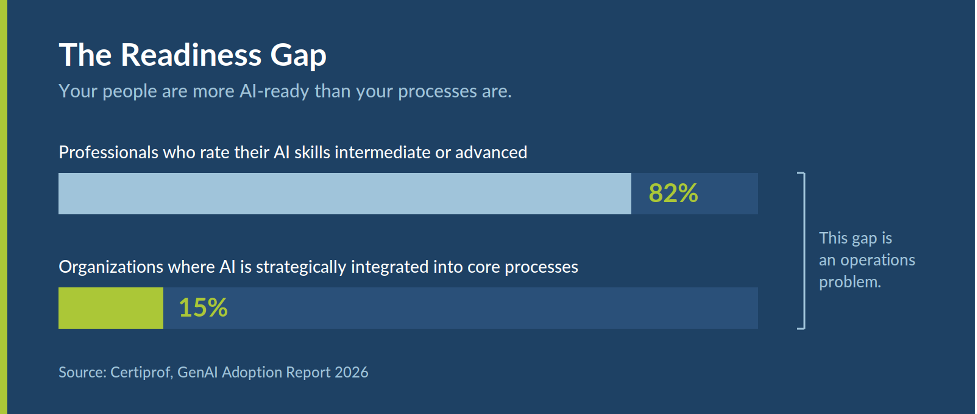
Look at where most organizations actually stand.
Boards are starting to notice. KPMG’s global AI risk chief put it plainly in a recent Fortune interview: the oversight models most companies rely on were built for “deterministic systems”. AI is probabilistic, and once it is embedded in the work, those old models will lead to operational failure.
This forces a question every leader needs to ask: Have we evolved our operating model to match the maturity of the AI we now depend on? Or are we still treating a strategic capability like a temporary pilot project?
Two eras, two scoreboards
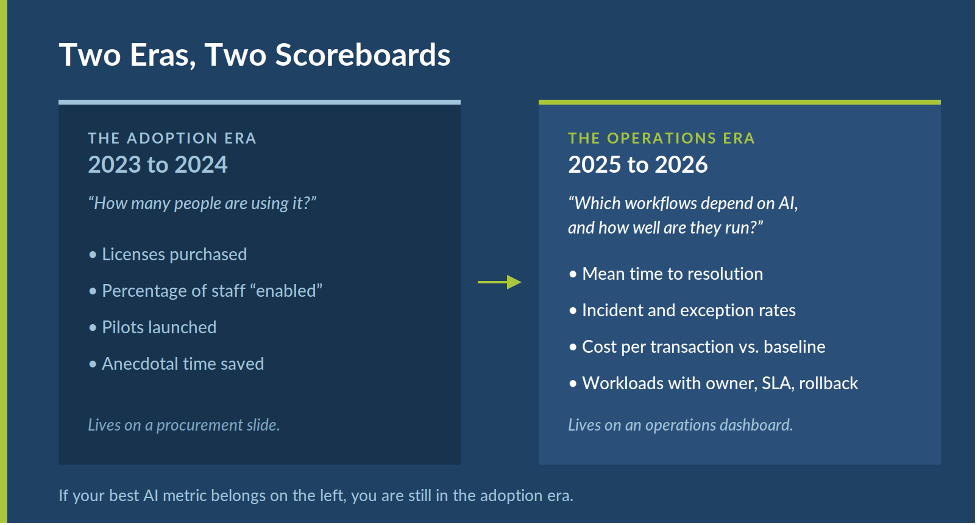
What changed is not the tools. Capital is no longer the main barrier either. The blockers now are governance, process redesign, and skills.
And most of us did not redesign anything. We layered AI on top of the workflows we already had. Certiprof’s data suggests the organizations willing to genuinely redesign the work are far more likely to see real productivity gains. The lesson is familiar to anyone who has led a systems migration. Pave the cow path, and you get a faster cow path. Not a better business.
License counts feel reassuring, but they tell you almost nothing about whether AI is safe, cost effective, or creating value. The Thomson Reuters Institute found that only about 18 percent of organizations track the return on their AI tools, roughly flat year over year. You cannot prove an ROI you never measured. You cannot govern what you cannot see.
The new boardroom questions
In April 2026, KPMG and INSEAD published a set of AI Governance Principles for Boards. The message running through them is consistent. Boards must move from passive awareness to active stewardship.
For most executives, that lands better as questions than as philosophy. Lift these onto your next agenda:
- Which business-critical processes now rely on AI, and what happens if those models degrade or go offline?
- How much are we actually spending across tools, clouds, and the AI features quietly embedded in software we already pay for?
- Who is accountable when AI shapes a regulatory or customer-facing outcome?
- Are we preserving human judgment, or are we learning to hide behind “the model said so”?
The quality of the answers will tell you which era you are operating in.
Building the operational spine
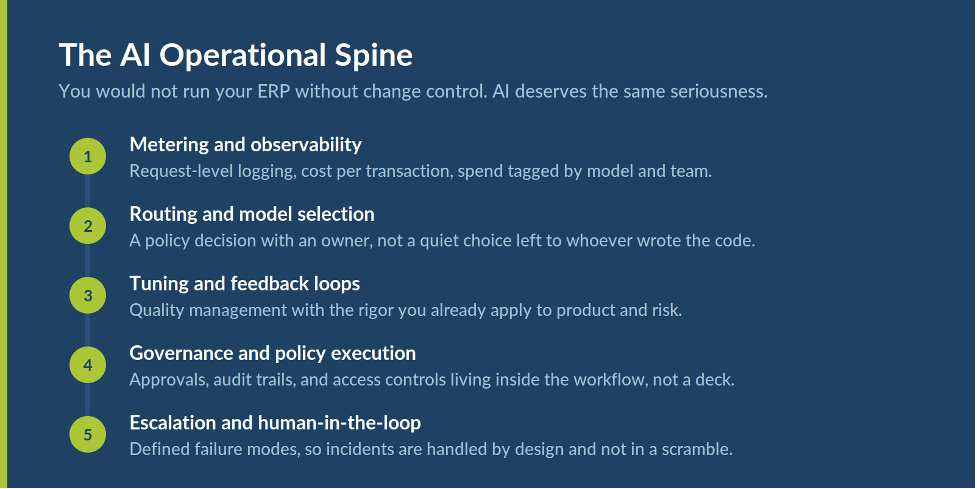
None of this is exotic. It is the ordinary discipline of running something that matters.
Why this hits smaller companies harder
Large enterprises can throw dedicated teams at the problem. Governance committees. FinOps functions. Platform staff whose only job is to run this.
Most mid-market companies cannot. In reality, AI operations land on the CFO, the COO, or the head of IT, people who already have full plates and no operating model built for this.
So the transition happens one of two ways. Deliberately, through a lean model you design on purpose. Or in crisis, in reaction to a surprise invoice, an embarrassing incident, or a customer question you cannot answer.
Two failure modes claim the companies that get it wrong. The first is blind expansion: fast rollout, no cost visibility, governance gaps, margins eroding quietly. The second is blind cost-cutting: panic at the invoice, slash licenses indiscriminately, lose competitive ground and demoralize the teams that were actually delivering.
The path between them is narrower than the enterprise version and just as effective. Name an owner. Write basic policies. Set a reporting rhythm. Prioritize visibility and accountability over a bigger tool stack.
Treating AI as an operated capability
The organizations pulling ahead stopped treating AI as a pile of subscriptions and started treating it as an operated capability. Continuous ownership. Continuous monitoring. Lifecycle discipline. That is what turns AI from a volatile expense into a governed capability that compounds in value.
For most of us, the question is no longer whether AI will be operated this way. It is who will operate it. You can build the function internally, with the budget, people, and time that requires. Or you can partner with specialists who already run AI as an operated service. The honest answer depends on three things: how quickly you need to reach maturity, how demanding your regulators and customers are, and how much bandwidth you can realistically spare.
This is where a managed operations partner can carry real weight. This isn’t about handing off responsibility. Instead, it is a way to secure enterprise-grade discipline, visibility, and governance without building an entire internal function from scratch.
Either way, the first move is the same. You need a clear-eyed look at where you stand today.
Readiness is not a single number
Look again at that first chart. Eighty-two percent of professionals are ready. Fifteen percent of organizations are. The lesson buried in that gap is that readiness has more than one dimension, and strength in one reliably disguises weakness in another.
Capable people and unusable data. Clean data and no governance. Both of those, and still no agreed definition of what a win looks like. Any one of those gaps is enough to strand an AI program that looks perfectly healthy on a status slide.
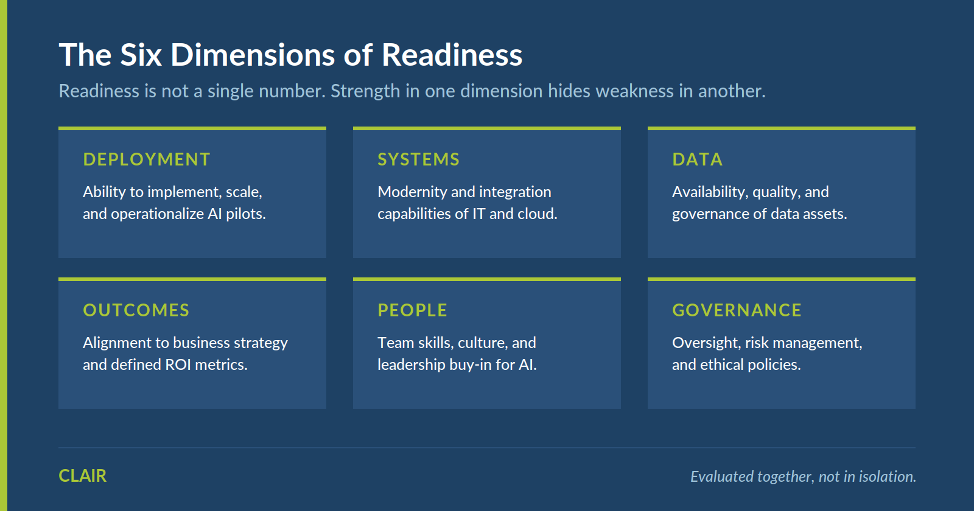
This is what CLAIR is built to surface. Our Consultant-Led AI Readiness assessment examines all six dimensions together, because judging any one of them in isolation is the same mistake as counting seats.
The point is not to hand you a roadmap. It is to prevent the most expensive failure we see, which is a confident investment in an ill-defined project. Where an organization is ready, the assessment becomes an on-ramp, with a foundation solid enough to operate on. Where it is not ready, you learn that before the invoice arrives rather than after.
You do not need us to begin. Map the AI you already run, name the owners, and list the metrics you actually track. If that exercise turns out to be hard, that difficulty is the finding. It means you crossed from adoption into operations without realizing it.
Remember: adopting the tools was never the hard part. Operating them effectively always was.
About ATB Technologies
ATB Technologies is an award-winning managed service provider (MSP) that helps businesses solve technology problems and navigate which solutions best support their business strategy and goals. Our IT experts help companies maximize their business IT while offering an exceptional level of customer service. We’re ready to help and provide IT support that never lets you down. ATB has been twice recognized by Inc. 5000 as one of the fastest-growing private companies in the U.S. Find out more at atb-tech.com.