
By Brian Butler | ATB Technologies | September 8, 2026
In less than six months, an organization can easily move from basic chatbots to autonomous agents that triage tickets, extract invoice data, and execute updates across core enterprise systems. The deployment feels like a clean win. Until an upstream API changed, a validation failed, and an agent entered a silent retry loop in the middle of the night against a production database. By morning the loop had written corrupted records across 1200 active customer accounts and locked core fulfillment during peak morning volume. Finance, operations, and IT were left scrambling to determine the blast radius before customers noticed the disruption.
When the leadership team gathered to manage the fallout, the central question was not why the agent made a mistake. The question was simpler and far more uncomfortable:
What are our agents actually doing right now? The reality is that probably no one knows.
Over the past two years, much of the technology conversation has centered on model benchmarks, prompt engineering, and context windows. That focus made sense when AI was primarily a research project or a conversational tool.
Autonomous agents, however, do not just generate text. They take action. They read files. They call external APIs, update databases, and trigger workflows across disconnected systems.
When an agent acts autonomously, the primary bottleneck is no longer model intelligence. The bottleneck is runtime visibility.
Consider the operational questions we face as leaders once agents enter production:
- How many agents are currently running across our environment?
- What specific tools, databases, and permissions do they have access to?
- When an execution fails silently at two in the morning, who receives the alert?
- If an agent begins hallucinating during an automated workflow, at what point does a human intervene?
If we cannot answer those questions with precision, the organization is not executing an automation strategy. It is accumulating operational debt.
The issue is this is not a theoretical technology concern. It is a governance, compliance, and balance-sheet risk.
We all know that when internal teams build ad-hoc agents to solve immediate problems, they design for the happy path. We build the agent assuming the APIs respond promptly, data formats remain consistent, and third-party models behave predictably.
But for all of us who have managed enterprise systems, we know they do not live on the happy path.
When an employee makes a procedural error, existing operational checks and management structures are designed to catch it. But what happens when an unmonitored autonomous agent fails? It repeats that failure at machine speed.
Unmonitored automations introduce substantial exposure:
- Data integrity risks: Agents writing corrupted or hallucinated data directly into systems of record.
- Financial risks: Unchecked retry loops and recursive calls that can consume API budgets overnight.
- Security and compliance risks: Ungoverned access to sensitive records without auditable trace logs.
Treating agent oversight as an afterthought turns every operational failure into an executive incident response drill.
The Mid-Market Advantage
There is a common assumption that large enterprises will inevitably dominate agent adoption due to their scale and resources. I am not convinced that is how this will play out.
Large enterprises are frequently paralyzed by governance committees. They spend quarters debating theoretical risk frameworks before a single agent touches a production database.
Mid-market organizations have a distinct window of opportunity. By adopting operational discipline early, a smaller firm can safely deploy agents faster than a Fortune 500 competitor stuck in committee review.
Operational guardrails do not slow down innovation. They accelerate it.
When leadership knows that an errant workflow will be isolated within seconds, the organization can afford to experiment boldly. Control creates speed.
What Managed Agent Operations Looks Like

In traditional enterprise IT, we never deploy servers, databases, or networks without telemetry, alerting thresholds, and clear incident ownership. We built Network Operations Centers (NOCs) and Security Operations Centers (SOCs) because infrastructure requires continuous oversight.
An autonomous digital workforce requires the exact same discipline.
Managed AI Agent Operations is not a one-time software configuration. It is an ongoing operational function built on four structural pillars:
- Fleet-Wide Observability: A centralized view of every agent operating within the business, including its version, operational health, and active integrations.
- Structured Execution Telemetry: Granular, auditable receipts of every prompt, tool call, API interaction, and state change.
- Exception Routing: Defined pathways that automatically detect logic loops, schema mismatches, or unexpected outputs, escalating them to human operators before downstream systems are affected.
- Multi-Level Kill Switches: The technical capability to pause a specific tool call, quarantine an individual agent, or halt an entire workflow instantly without bringing core enterprise systems down.
From Ad-Hoc Scripts to a Governed Harness
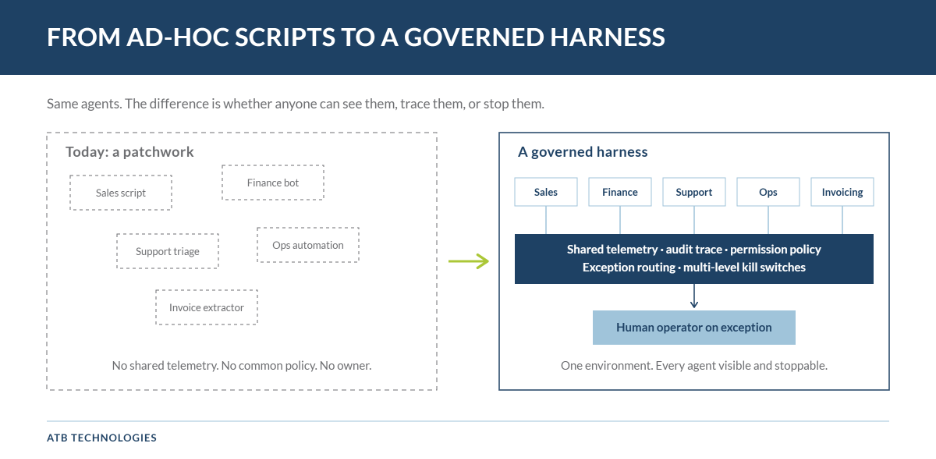
Operating without central oversight triggers agent rot. A power user creates a clever integration that runs reliably for three months. But when an authentication token expires or the author changes roles, the automation quietly breaks. The result is no one accountable to fix it.
When departments build tools in functional silos, the automations quickly become fragmented. At that point then we, as leadership, are left managing an unstable, uncoordinated patchwork.
This is where a governed harness changes that dynamic. It establishes a unified operating environment for every agent, no matter which department requested or built it. This ensures all agents share the same telemetry, security policies, and operational oversight.
An Operational Roadmap
Operational discipline does not require months of abstract planning. It requires methodical execution on the ground.

When organizations begin deploying automated workflows and autonomous agents, initial excitement usually centers on capability. Far less attention is given to how those systems will be managed when they behave in unexpected ways. If we want automation to create durable business leverage rather than unmanaged risk, we need a straightforward operational foundation.
- Visibility & Asset Mapping: Catalog every automated script, background workflow, and autonomous agent operating across the environment. Audit access permissions to determine the potential blast radius across connected systems. Assign a single, accountable business and technical owner to every automated outcome.
- Telemetry and Containment: Centralize full-payload logging and immutable audit trails across all active workflows. Deploy circuit breakers that give operations teams the ability to halt a process the moment an anomaly appears. Establish baseline operating parameters to distinguish normal variations from systemic failures.
- Exception Governance: Standardize the incident severity matrix upfront to remove ambiguity during an outage. Define clear operational responsibilities and escalation paths for alert monitoring. Implement expert-in-the-loop controls so engineers can safely intercept mid-flight workflows without breaking production.
As technology leaders, we cannot spend our time acting as emergency responders for unmonitored automations. The objective of deploying autonomous agents is to create leverage, improve customer outcomes, and build operational capacity. Achieving that return on investment requires treating automation with the same operational rigor we apply to the rest of our technology infrastructure.
When a leadership team with operational maturity gathers after a failure, the meeting feels different. How many customer records were affected? Which systems did the agent touch? When was the process halted, and who authorized the stop? Because the operational foundation exists, every question has an answer. And those answers arrive in minutes rather than days.
Instead of an organizational crisis, the failure is simply an operational event with telemetry, an assigned owner, and an established runbook. We do not treat a saturated circuit or a failed switch as a crisis of confidence in networking. We treat it as an event with an owner and a runbook, and we move on. That is not because networks stopped failing. It is because we built the operations center that makes their failures ordinary.
I would be willing to venture that the difference between those two leadership teams was never the design of their agents. One team could say exactly what their automation was doing. The other could not.
At ATB Technologies, we have seen that building an intelligent workflow is only the first step. The real work is engineering the operational backbone that supports it: clear accountability, runtime visibility, containment mechanisms, and hardened exception paths. That is the difference between an overnight failure triggering an executive fire drill and one that generates a standard service ticket.
Clever prompts do not scale. Operational visibility does. The organizations that realize lasting value from autonomous systems will be the ones that can look at their production environment at 2:00 AM and account for every decision their technology makes.